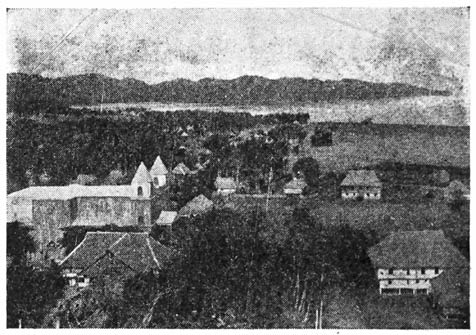
The deportee could have stayed in the Dapitan parish convent had he retracted his anti-Catholic pronouncements and made a general confession of his past life. Not willing to accede to these main conditions set by the Jesuits, Jose Rizal instead opted to live at the commandant's residence called "Casa Real."
The commandant Captain Ricardo Carnicero and Jose Rizal became such good friends that the exile did not feel that the captain was actually his guard. Later in his life in Dapitan, Rizal wrote a poem A Don Ricardo Carnicero honoring the kind commandant on the occasion of his birthday on August 26, 1892.
In September 1892, Rizal and Carnicero won in a lottery. The Manila Lottery ticket no. 9736 jointly owned by Rizal, Carnicero, and a Spanish resident of Dipolog won the second prize of Php 20, 0000. Rizal used some part of his share (Php 6,200) in procuring a parcel of land near the coast of Talisay, a barrio near Dapitan. On a property of more than 10 hectares, he put up three houses made of bamboo, wood, and nipa. He lived in the house, which was square in shape. Another house, which was hexagonal, was the barn where Rizal kept his chickens. In his octagonal house lived some of his pupils for Rizal also established a school, teaching young boys practical subjects, like reading, writing, arithmetic, geography, and Spanish and English languages. Later, he constructed additional huts to accommodate his recovering out-of-town patients.
During his exile, Rizal practiced medicine, taught some pupils, and engaged in farming and horticulture. He grew many fruit trees (like coconut, mango, lanzones, makopa, santol, mangosteen, jackfruit, guayabanos, baluno, and nanka) and domesticated some animals (like rabbits, dogs, cats, and chickens). The school he founded in 1893 started with only three pupils and had about more than 20 students at the time his exile ended.
Rizal would rise at five in the morning to see his plants, feed his animals, and prepare breakfast. Having taken his morning meal, he would treat the patients who had come to his house. Paddling his boat called baroto (he had two of them), he would then proceed to Dapitan town to attend to his other patients there the whole morning.
Rizal would return to Talisay to take his lunch. Teaching his pupils would begin at about 2 p.m. and would end at 4 or 5 in the afternoon. With the help of his pupils, Rizal would spend the rest of the afternoon in farming-planting trees, watering the plants, and pruning the fruits. Rizal then would spend the night reading and writing.
The first attempt by the Jesuit friars to win back the deported Rizal to the Catholic fold was the offer for him to live in the Dapitan convent under some conditions. Refusing to compromise, Rizal did not stay with the parish priest Antonio Obach in the church convent.
Just a month after Rizal was deported to Dapitan, the Jesuit Order assigned to Dapitan the priest Francisco de Paula Sanchez, Rizal's favorite teacher in Ateneo. Many times, they engaged in cordial religious discussions. But though Rizal appreciated his mentor's efforts, he could not be convinced to change his mind. Nevertheless, their differences in belief did not get in the way of their good friendship.
The priest Pablo Pastells, superior of the Jesuit Society in the Philippines, also made some attempts by correspondence to win over to Catholicism the exiled physician. Four times they exchanged letters from September 1892 to April 1893. The debate was none less than scholarly, and it manifested Rizal's knowledge of the Holy Scriptures for he quoted verses from it. Though Rizal consistently attended mass in Dapitan, he refused to espouse the conventional type of Catholicism.